
 AU
AU USA
USA UK
UK ES
ES FR
FR BR
BR TH
TH IN
INShift worker burnout and how to manage
Why are shift workers burning out faster than ever? and can be done about it?
You watch your team arrive for their shift and you notice it straight away. The energy is flatter than it used to be. The quick jokes aren’t happening. Someone’s snapping at a coworker over something small. And when you ask how they’re doing, you get a tight smile and “yeah, all good” – but you know they’re not.
This isn’t just a feeling. In Q3 2025, 40% of Australian employees reported feeling burnt out. For shift workers – the people who keep hospitality venues running, NDIS care services staffed, and industrial operations moving, that number climbs higher. But here’s what often gets missed: shift worker burnout isn’t the same as regular job stress. It’s unique, compounding, and it happens faster.
The difference is rhythm. Office workers can predict their week. Shift workers live in fragmentation. Their body clock never settles. Social plans crumble. Sleep becomes a luxury. And if your rostering system makes it worse, changing shifts at the last minute, with no way for people to swap, no visibility into what’s coming – you’re not just managing a tired team. You’re actively building the conditions for burnout.
The good news? You can change this. Not by working harder or pushing through. By actually listening to what your team needs and building a rhythm they can count on.
The real cost of unpredictability
Shift work is inherently unpredictable in ways that office work isn’t. Your barista doesn’t know if tomorrow will be a lunch rush or a quiet Tuesday. Your disability support worker doesn’t control which clients she’ll be caring for or how their needs might shift. That’s the nature of the work.
But there’s a difference between the unavoidable uncertainty of the job itself and the uncertainty you create through poor scheduling. When rosters change without notice, when people find out their shift is cancelled 24 hours before they were supposed to work, when there’s no way to swap with a coworker who has that day off, you’re adding a layer of stress that has nothing to do with the actual work.
This uncertainty has real physical consequences. Your nervous system stays in a low-level alert state. Cortisol levels stay elevated. Sleep becomes harder, even on nights when you’re technically “off”. You can’t plan anything with certainty – childcare, transport, even just a reliable dinner time. Over months, this becomes exhaustion that no amount of sleep on a weekend can fix.
For team leaders and business owners, the impact is direct. Burnt-out shift workers call in sick more often. Turnover spikes, and the cost of replacing skilled hospitality, care, or industrial staff is significant. More subtly, engagement drops. People show up, do their job, and leave. The loyalty and discretionary effort that makes a team function smoothly – the person who stays late to help a struggling coworker, who mentors new staff, who takes pride in their work – that disappears.
Stability doesn’t mean less flexibility
Here’s where many employers get stuck. They think that fixing burnout means reducing the number of shifts people work, or locking everyone into rigid schedules. Neither is realistic or necessary.
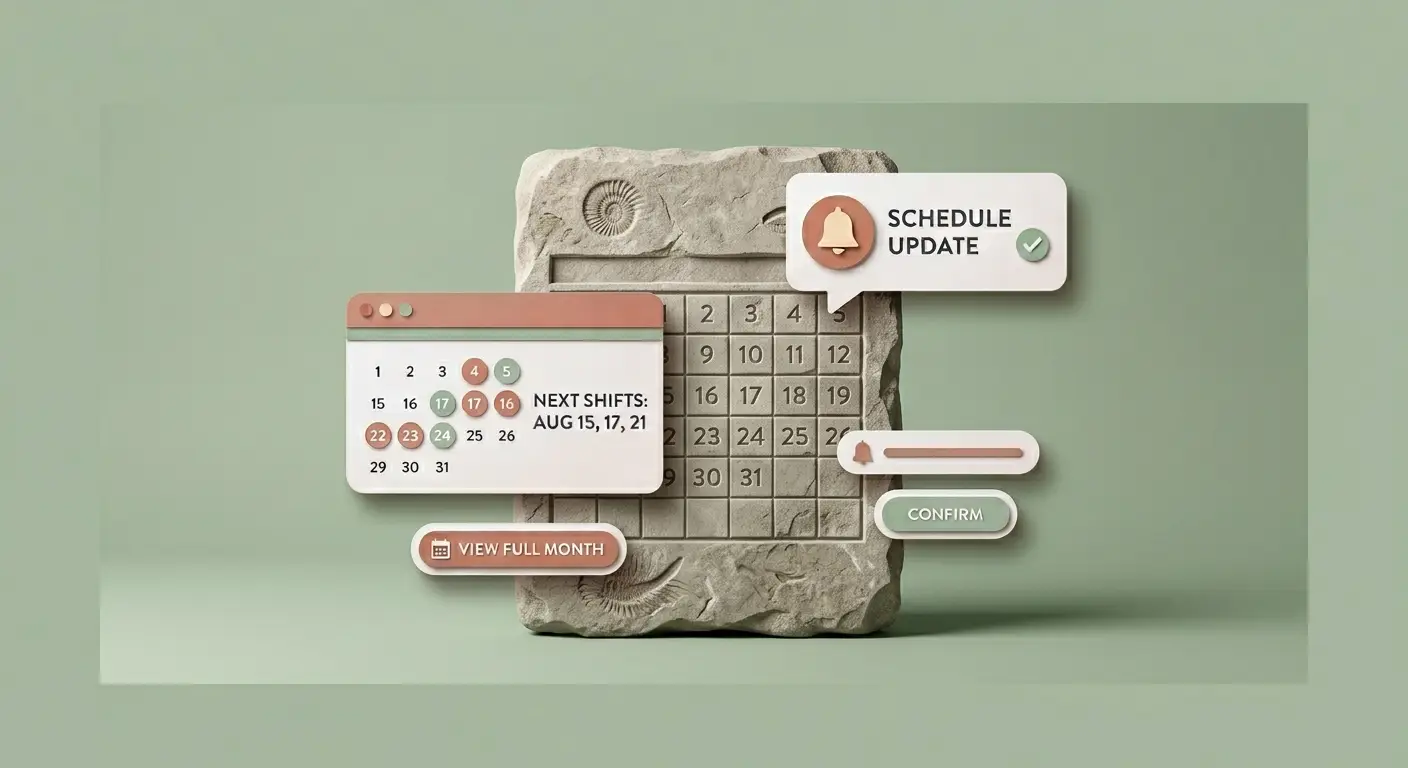
What works is predictability with flexibility. It means publishing rosters far enough in advance that people can plan their lives. It means having a clear system for shift swaps so that if something comes up, your team member can solve it themselves instead of going to a manager. It means communicating changes early, with genuine notice, not at the last minute.
Some of the most engaged shift teams we’ve seen are ones where the roster is clear three weeks out. They know roughly what they’re working, they can arrange childcare or transport or social plans. And when something does need to change, it’s handled transparently, ideally with the team member’s input.
The paradox is that this kind of stability actually makes your rostering more flexible, not less. When people have visibility and control, when they can offer available shifts to the team, when they can see what’s coming and adjust, they’re more willing to pick up extra work when you genuinely need them. When people feel like their schedule is done to them, not with them, they become defensive. They’ll say no to extra shifts. They’ll look for another job. They’ll burn out.
What this looks like in practice
A hospitality group in Brisbane started seeing the same pattern. Good staff, decent pay, but turnover was high and the remaining team looked exhausted. They made three changes.
First, they moved to publishing rosters two weeks ahead instead of a few days. Sounds simple, but it meant the team could actually plan.
Second, they created a shift swap system where people could propose swaps directly, instead than going through a manager. Approval took minutes instead of being a negotiation that happened in bits of quiet time.
Third, they started sharing actual workload data – not just shifts, but a simple weekly view of how many shifts each person was working, so busy periods were visible to everyone. No one was suddenly discovering they’d been scheduled for five nights in a row by surprise.
Within two months, requests for shifts off dropped – because people actually had time to ask for them. Turnover dropped too. And when we asked the team to rate their stress around scheduling specifically, the numbers improved significantly.
The role of small, consistent systems
Burnout often gets framed as an individual problem – “you need to take better care of yourself” or “you’re not managing your stress.” But when 40% of Australian employees are burnt out, and shift workers are even higher, that’s not an individual failing. That’s a system problem.
You can’t fix a system problem with individual effort. Your team member can’t meditate their way out of unpredictable rosters. They can’t sleep better if they don’t know when they’re working. What they need is for their workplace to stop building stress into the structure itself.
The good news is that the fixes are usually small and consistent. A roster published early. A clear communication when something changes. A simple way to swap shifts without friction. A manager who understands that “how are you?” isn’t a greeting – it’s a genuine question that deserves a real answer.
These aren’t big changes. But they’re the difference between a team that feels respected and protected, and one that feels pulled in different directions every week.
Building a workplace where people can actually thrive
Shift work will always be demanding. Your team will always be managing complexity that an office worker doesn’t see. But burnout isn’t inevitable. It’s a signal that something in the system needs to change.
When you listen to what your team is actually experiencing — the anxiety of not knowing their schedule, the frustration of last-minute changes, the relief when something goes as planned — you start to see the levers you can pull. And many of them are within your control.
The goal isn’t to make shift work easy. It’s to make it predictable, respectful, and manageable. It’s to build a rhythm that your team can count on, so they can bring their full selves to work instead of just surviving until the shift ends. That’s where the magic happens. That’s where burnout starts to fade, and engagement comes back.
At Tommy, we believe a better workday starts with clarity, connection, and respect for people’s time. Scheduling, team communication, and attendance – all in one place, so your team can stay informed and in sync without the back-and-forth.