 AU
AU USA
USA UK
UK ES
ES FR
FR BR
BR TH
TH IN
INWorld Health Day: What A Healthy Workplace Looks Like

Most health advice assumes a stable life.
Eat well. Exercise. Get eight hours of sleep. Manage your stress.
Good advice, in theory. But if you work shifts, almost every one of those things is actively harder. Not because of personal discipline, but because of the structures your workplace either has or doesn’t have.
This World Health Day, it’s worth being honest about something: for shift workers, health isn’t mainly an individual challenge. It’s a systemic one. And the systems that affect it most are the ones sitting in your operations: your roster, your communication tools, your pay visibility, your scheduling lead time.
Here’s what genuine workplace health actually looks like for shift-based teams.
Why Shift Work Makes Health So Much Harder
Your body is built for rhythm. Morning light. Activity. Food at predictable times. Sleep. Repeat. When that pattern is stable, your body adapts and your systems settle.
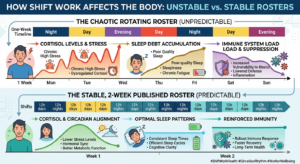
Shift work disrupts that rhythm. And when the roster is also unpredictable – when your team finds out their hours three days before the week starts, the body stays in a low-level alert state. Cortisol stays elevated. Sleep quality drops even when hours are technically adequate. Recovery doesn’t stick because the underlying stress doesn’t let up.
This is physiology, not weakness. And it explains why shift workers report higher rates of sleep disorders, persistent fatigue, and digestiveissues at rates well above the general workforce.
What helps isn’t a different morning routine. It’s predictability. Two weeks of schedule visibility can shift a team’s collective health more than any wellness initiative.
The Mental Load Nobody Talks About
The stress of shift work isn’t usually dramatic. It’s low-level and relentless.
Do I have enough hours this week? Can I commit to my daughter’s sports game? Will this shift get cancelled again?
These questions run in the background constantly. And constant low-grade uncertainty is, over time, genuinely exhausting in a way that a good night’s sleep can’t fix.
A stable, predictable schedule does something simple: it lets people exhale. They can plan. They can look forward to things. They can say yes to their family instead of “I’ll have to check.”
One useful way to think about team morale is what we call the “Friday feeling.” When your team’s week ends, do they feel genuinely finished – or are they just glad to finally escape the uncertainty? A healthy workplace creates that Friday feeling by design, not by accident.
Social Connection Is a Health Issue Too
Shift workers often miss the events everyone else takes for granted – weekend gatherings, weeknight dinners, school pick-ups. This isn’t a personal failing. It’s a structural reality.
But unpredictable scheduling makes it significantly worse. If you don’t know your roster until three days out, you can’t commit to anything. You become the friend who always cancels. The family member who’s always unavailable. Over time, that has real consequences for connection and belonging, both of which have documented links to physical health outcomes.
A stable roster doesn’t solve every social challenge that comes with shift work. But it makes reliability possible. Your team members can actually plan. They can say yes with confidence. They can be present in their own lives.
Financial Stress Is Physical Stress
This one often gets left out of workplace health conversations. It shouldn’t!
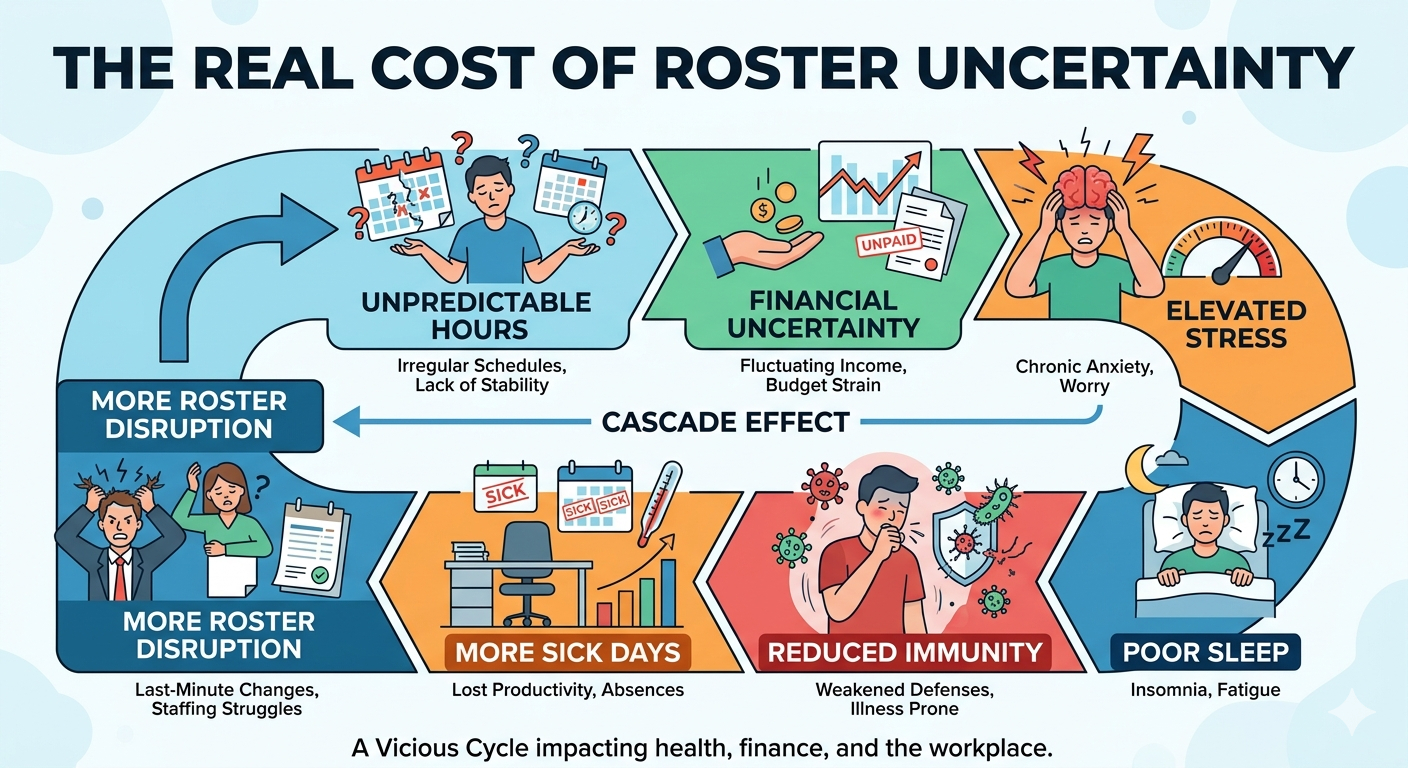
For shift workers on minimum wages, the difference between 35 hours and 28 hours in a week is significant and if the roster is unpredictable, they don’t know which one it’ll be until the week has started. That uncertainty keeps the nervous system activated. It’s constant background math: what if the hours drop? What do I cut?
Financial stress doesn’t stay in your head. It drives elevated cortisol, disrupted sleep, and reduced immunity, the same cycle that unpredictable scheduling creates.
Schedule visibility reduces this burden. Not because the pay increases, but because people can finally plan. The anxiety comes down when the uncertainty does.
Work/Life Harmony — Better Than “Balance”
Most workplaces talk about work-life balance. It’s a phrase that implies two separate things on a scale, competing against each other.
For shift workers, that’s not the reality. Work is part of life. The question isn’t whether they balance evenly, it’s whether they can coexist without constant friction.
Harmony is a more useful idea. A harmonious workplace is one where the schedule respects people’s lives. Where your team can plan a meal, a weekend, a child’s event, because the roster was published far enough ahead to make that possible.
When harmony exists, health outcomes follow. People sleep more consistently. Relationships are easier to maintain. The low-level anxiety that comes from constant uncertainty subsides.
What a Genuinely Healthy Shift Workplace Looks Like
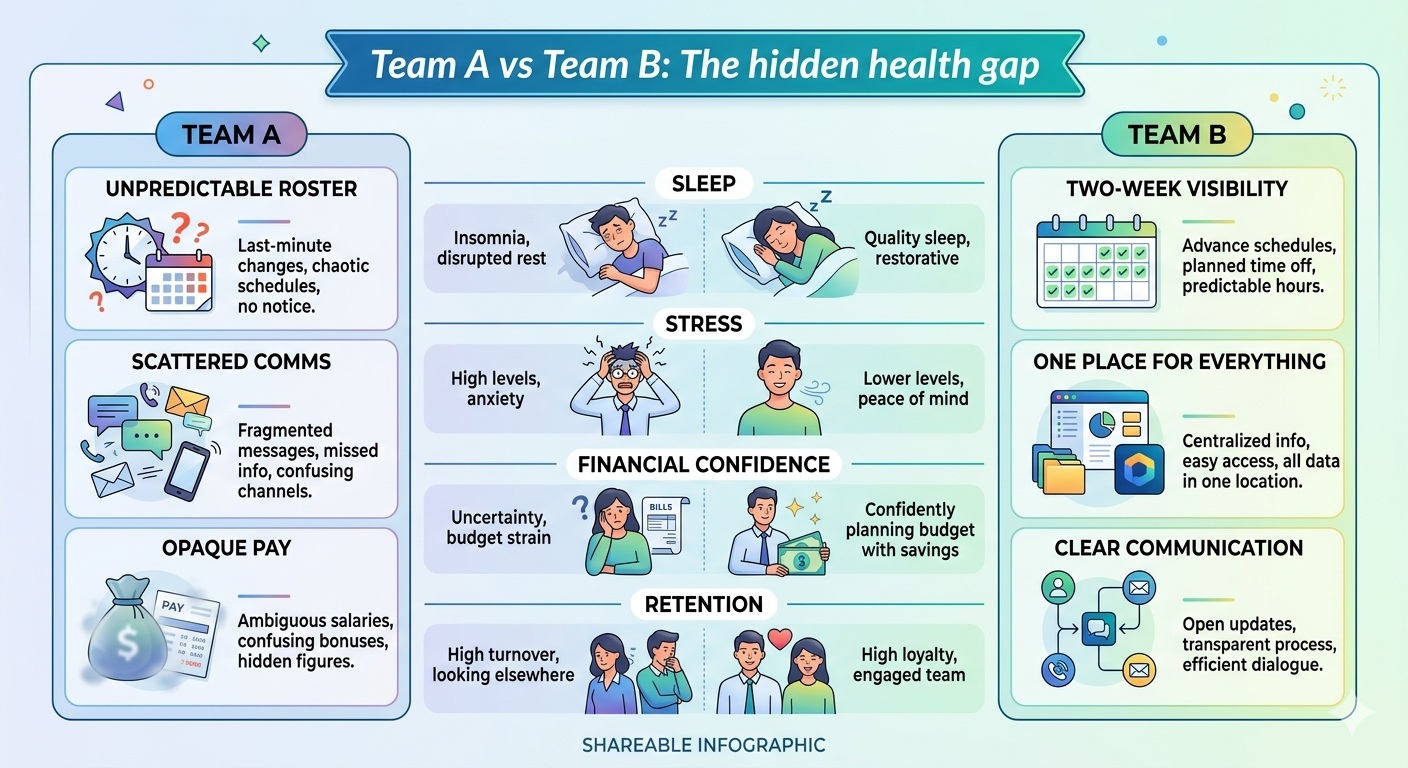
Picture two teams.
Team A: The roster is published two weeks ahead. Shift swaps are easy to arrange. Pay and hours are visible at any time. There’s one place for schedules, updates, and messages. Management communicates clearly. People feel trusted to do their work.
Team B: Shifts change constantly with little notice. Updates come via group text at 10pm. Checking pay requires asking three different people. Communication is scattered. People feel watched.
The health difference between these teams is real and measurable. Team A has lower stress, more consistent sleep, and stronger relationships. They report higher satisfaction. Their turnover is lower. The work actually gets done better, not just because they’re more engaged but because they’re healthier.
The good news: getting from Team B to Team A isn’t primarily a budget question. It’s a systems question.
Health Is Systemic & That’s Good News
Here’s what often gets missed in conversations about workplace wellness: individual choices matter far less than the systems people are working within.
Telling a shift worker to sleep better is reasonable advice. But it doesn’t help much if their roster gives them 48 hours notice before a 5am start. Telling them to manage stress is fair. But not if they’re constantly uncertain about their hours and pay.
When you build systems that support health – predictable schedules, visible pay, clear communication, easy shift coordination – you’re not asking people to try harder. You’re removing the barriers your workplace was creating.
That’s what a genuinely health-conscious workplace looks like. Not wellness posters or meditation apps (though rest matters). But actual operational structures that create the conditions for your team to be well.
If You’re Leading a Shift-Based Team
World Health Day is a useful prompt to ask honestly: are your systems working for your team’s health, or against it?
A few things come up consistently in healthy shift workplaces:
Publish rosters well ahead. Two weeks gives people enough lead time to plan sleep, family, and life around a predictable pattern.
Make shift swaps simple. If covering a conflict requires a chain of texts and manager approvals, people will avoid it and just show up exhausted instead.
Give people visibility over their pay. They shouldn’t have to guess or ask. Visible hours and pay reduces financial anxiety week to week.
Keep communication in one place. Scattered messages across texts, WhatsApp, email, and noticeboards create confusion and stress. One clear channel changes the feel of the whole workday.
Be clear and consistent. Uncertainty breeds anxiety. Clear, honest communication from management is a health intervention in its own right.
None of these require a bigger budget. Many of them reduce turnover and save time. What they do is send a signal your team will notice: your life outside work matters here.
That’s what health looks like for shift workers. Not perfection. Predictability. Respect. Systems that are built for human beings.
At Tommy, we believe a better workday starts with clarity, connection, and respect for people’s time. Scheduling, team communication, and attendance – all in one place, so your team can stay informed and in sync without the back-and-forth.