


Employee Wellness

illustration of a paper plane doing a circle on the left and on the right a paper plane swirling around in complexity

Five signs your shift rostering software is making your team anxious

There’s a difference between being busy and being anxious. Busy is normal. Anxiety is a signal that something in your system isn’t working. Your team member might be handling a full shift without any problems. But if they’re constantly anxious about what comes next, about schedule changes, about whether they’ll have enough hours, about how to plan their life around unpredictability – that’s not just being busy. That’s your shift rostering software creating stress. And it’s not a small thing. Research from Harvard’s Shift Project, studying over 20,000 service sector workers, found that unstable and unpredictable work schedules have substantially larger negative associations with psychological distress, sleep quality, and happiness than even wages do. The schedule matters more than most managers realise.   These five signs suggest your rostering process is actively making your team anxious. And once you can see them, you can fix them. Sign 1: People aren’t asking for time off. They’re asking for shifts back Notice a pattern in the requests your team is making? They’re not saying “can I have Thursday off?” They’re saying “can I get my Thursday shift back?” or: “what’s my schedule looking like?”. This is a sign that people don’t feel secure about their baseline hours. They don’t know if they’ll have enough work. And instead of confidently requesting time off when they need it, they’re anxious about losing hours. From a manager’s perspective, this can look like engagement. People are keen to work. But it’s actually the opposite — it’s anxiety masquerading as commitment. They’re likely not eager to work. They’re more likely to be worried about income stability. Good shift rostering software creates the opposite pattern. People know their baseline hours are solid. So when they need time off, they just ask for it. Or they swap a shift with a colleague. The relationship to work becomes more secure, and less anxiety-driven. Sign 2: The same questions get asked repeatedly You’ve told your team member their schedule. They’ve acknowledged it. And 24 hours later, they’re asking again. Or someone asks you what the roster looks like – when they could check it themselves but they’re not sure where or how. This happens when the schedule isn’t visible, or it’s in too many places, or people don’t trust that it’s accurate. So they keep double-checking, because the anxiety of not knowing is higher than the social cost of asking the same question twice. This is exhausting for managers. But it’s also a sign of underlying anxiety. Your team member wouldn’t keep asking if they felt confident about the information or there was a true single source of truth on where to find it. What fixes this is shift rostering software that gives everyone one place to look – updated in real time, trusted to be accurate, and visible to anyone who needs it. The repeated questions stop almost immediately. Sign 3: Roster changes create reactions, not adjustments When you change a shift, what happens? Does your team member take a moment to adjust and then move on? Or do they react emotionally with frustration, anger, or resignation? This isn’t about them being difficult. It’s about the impact of change on an already anxious system. If someone is already uncertain about their schedule, a roster change feels like one more destabilising thing. It confirms their anxiety that they can’t rely on anything. If someone feels secure and stable, a roster change is still inconvenient but it’s different. It’s something to solve, not something to resent. Strong emotional reactions to schedule changes are often a sign that underlying roster anxiety is already high. The change itself is just the visible symptom. And if your shift rostering software doesn’t make changes visible quickly and clearly, it’s making that worse. Sign 4: People are giving you information your system should already have Your shift rostering software should be telling you: this person has worked 42 hours this week. This person is approaching their maximum. This person hasn’t had enough shifts lately. This part of the schedule is particularly tiring. But instead, your people are telling you. “I’ve been on a lot this week/month.” “I’m pretty tired – can I get a lighter shift?” or “Any chance of extra hours? I’m running short.” They’re giving you information that your system should be providing. This happens because your roster is fragmented – the schedule in one place, timesheets in another, compliance rules somewhere else, and perhaps your software doesn’t have healthy best practices built-in. Nobody has a single view of what’s actually happening. Your team shouldn’t have to be their own workload monitor. When they are, it costs them mental energy they’d rather spend on the job. That’s anxiety the right rostering software should be preventing. Sign 5: Nobody knows who’s available for what You need someone to cover a shift. So you start texting around. Or you mention it at the end of a handover and see who bites. Or there’s a person you always call because you know they’ll say yes. This is the opposite of a structured system. And it creates anxiety in multiple directions. People are uncertain whether they’ll get asked. People who do get asked feel obligated, even if they don’t really want the shift. Management is stressed about coverage right up until the shift starts. Shift rostering software with open shift visibility changes this entirely. People can see available shifts and volunteer. There’s a swap system. There’s a fair request process that doesn’t rely on relationships or social obligation. When availability and coverage are handled ad-hoc, everyone’s carrying more than they should. The workers wondering if they’ll get hours. The person who always gets the call. The manager crossing their fingers at 6am. What these signs have in common All five signs are ways your team is managing the uncertainty that your rostering system is creating for them. They’re not signs that your team is unmotivated or difficult. They’re signs that your system is making people spend mental energy

picture of a park with world health day over the top

World Health Day: What A Healthy Workplace Looks Like

Most health advice assumes a stable life.Eat well. Exercise. Get eight hours of sleep. Manage your stress. Good advice, in theory. But if you work shifts, almost every one of those things is actively harder. Not because of personal discipline, but because of the structures your workplace either has or doesn’t have. This World Health Day, it’s worth being honest about something: for shift workers, health isn’t mainly an individual challenge. It’s a systemic one. And the systems that affect it most are the ones sitting in your operations: your roster, your communication tools, your pay visibility, your scheduling lead time. Here’s what genuine workplace health actually looks like for shift-based teams. Why Shift Work Makes Health So Much Harder Your body is built for rhythm. Morning light. Activity. Food at predictable times. Sleep. Repeat. When that pattern is stable, your body adapts and your systems settle. Shift work disrupts that rhythm. And when the roster is also unpredictable – when your team finds out their hours three days before the week starts, the body stays in a low-level alert state. Cortisol stays elevated. Sleep quality drops even when hours are technically adequate. Recovery doesn’t stick because the underlying stress doesn’t let up. This is physiology, not weakness. And it explains why shift workers report higher rates of sleep disorders, persistent fatigue, and digestiveissues at rates well above the general workforce. What helps isn’t a different morning routine. It’s predictability. Two weeks of schedule visibility can shift a team’s collective health more than any wellness initiative. The Mental Load Nobody Talks About The stress of shift work isn’t usually dramatic. It’s low-level and relentless. Do I have enough hours this week? Can I commit to my daughter’s sports game? Will this shift get cancelled again? These questions run in the background constantly. And constant low-grade uncertainty is, over time, genuinely exhausting in a way that a good night’s sleep can’t fix. A stable, predictable schedule does something simple: it lets people exhale. They can plan. They can look forward to things. They can say yes to their family instead of “I’ll have to check.” One useful way to think about team morale is what we call the “Friday feeling.” When your team’s week ends, do they feel genuinely finished – or are they just glad to finally escape the uncertainty? A healthy workplace creates that Friday feeling by design, not by accident. Social Connection Is a Health Issue Too Shift workers often miss the events everyone else takes for granted – weekend gatherings, weeknight dinners, school pick-ups. This isn’t a personal failing. It’s a structural reality. But unpredictable scheduling makes it significantly worse. If you don’t know your roster until three days out, you can’t commit to anything. You become the friend who always cancels. The family member who’s always unavailable. Over time, that has real consequences for connection and belonging, both of which have documented links to physical health outcomes. A stable roster doesn’t solve every social challenge that comes with shift work. But it makes reliability possible. Your team members can actually plan. They can say yes with confidence. They can be present in their own lives. Financial Stress Is Physical Stress This one often gets left out of workplace health conversations. It shouldn’t! For shift workers on minimum wages, the difference between 35 hours and 28 hours in a week is significant and if the roster is unpredictable, they don’t know which one it’ll be until the week has started. That uncertainty keeps the nervous system activated. It’s constant background math: what if the hours drop? What do I cut? Financial stress doesn’t stay in your head. It drives elevated cortisol, disrupted sleep, and reduced immunity, the same cycle that unpredictable scheduling creates. Schedule visibility reduces this burden. Not because the pay increases, but because people can finally plan. The anxiety comes down when the uncertainty does. Work/Life Harmony — Better Than “Balance” Most workplaces talk about work-life balance. It’s a phrase that implies two separate things on a scale, competing against each other. For shift workers, that’s not the reality. Work is part of life. The question isn’t whether they balance evenly, it’s whether they can coexist without constant friction. Harmony is a more useful idea. A harmonious workplace is one where the schedule respects people’s lives. Where your team can plan a meal, a weekend, a child’s event, because the roster was published far enough ahead to make that possible. When harmony exists, health outcomes follow. People sleep more consistently. Relationships are easier to maintain. The low-level anxiety that comes from constant uncertainty subsides. What a Genuinely Healthy Shift Workplace Looks Like Picture two teams. Team A: The roster is published two weeks ahead. Shift swaps are easy to arrange. Pay and hours are visible at any time. There’s one place for schedules, updates, and messages. Management communicates clearly. People feel trusted to do their work. Team B: Shifts change constantly with little notice. Updates come via group text at 10pm. Checking pay requires asking three different people. Communication is scattered. People feel watched. The health difference between these teams is real and measurable. Team A has lower stress, more consistent sleep, and stronger relationships. They report higher satisfaction. Their turnover is lower. The work actually gets done better, not just because they’re more engaged but because they’re healthier. The good news: getting from Team B to Team A isn’t primarily a budget question. It’s a systems question. Health Is Systemic & That’s Good News Here’s what often gets missed in conversations about workplace wellness: individual choices matter far less than the systems people are working within. Telling a shift worker to sleep better is reasonable advice. But it doesn’t help much if their roster gives them 48 hours notice before a 5am start. Telling them to manage stress is fair. But not if they’re constantly uncertain about their hours and pay. When you build systems that support health – predictable schedules, visible pay,

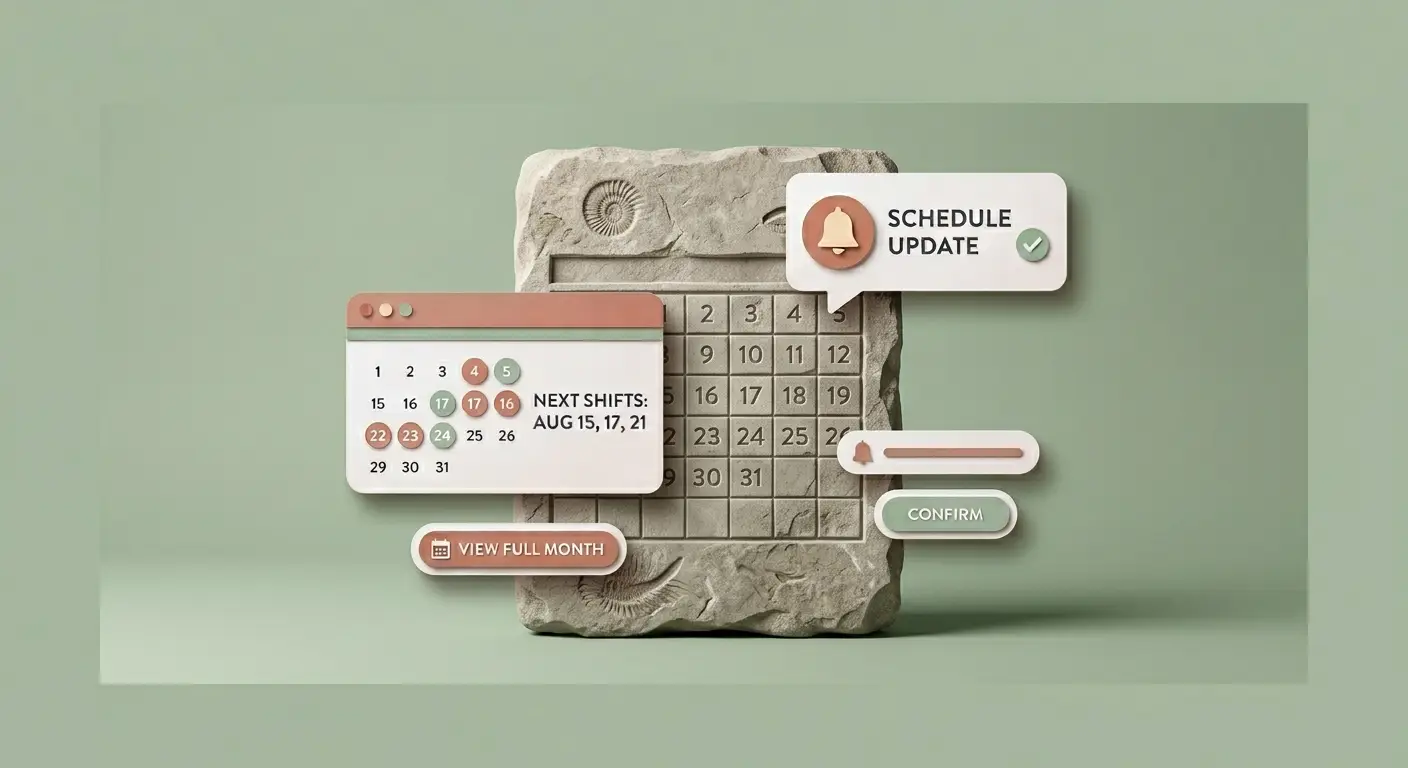
Calendar set in stone

Shift worker burnout and how to manage

Why are shift workers burning out faster than ever? and can be done about it? You watch your team arrive for their shift and you notice it straight away. The energy is flatter than it used to be. The quick jokes aren’t happening. Someone’s snapping at a coworker over something small. And when you ask how they’re doing, you get a tight smile and “yeah, all good” – but you know they’re not. This isn’t just a feeling. In Q3 2025, 40% of Australian employees reported feeling burnt out. For shift workers – the people who keep hospitality venues running, NDIS care services staffed, and industrial operations moving, that number climbs higher. But here’s what often gets missed: shift worker burnout isn’t the same as regular job stress. It’s unique, compounding, and it happens faster. The difference is rhythm. Office workers can predict their week. Shift workers live in fragmentation. Their body clock never settles. Social plans crumble. Sleep becomes a luxury. And if your rostering system makes it worse, changing shifts at the last minute, with no way for people to swap, no visibility into what’s coming – you’re not just managing a tired team. You’re actively building the conditions for burnout. The good news? You can change this. Not by working harder or pushing through. By actually listening to what your team needs and building a rhythm they can count on. The real cost of unpredictability Shift work is inherently unpredictable in ways that office work isn’t. Your barista doesn’t know if tomorrow will be a lunch rush or a quiet Tuesday. Your disability support worker doesn’t control which clients she’ll be caring for or how their needs might shift. That’s the nature of the work. But there’s a difference between the unavoidable uncertainty of the job itself and the uncertainty you create through poor scheduling. When rosters change without notice, when people find out their shift is cancelled 24 hours before they were supposed to work, when there’s no way to swap with a coworker who has that day off, you’re adding a layer of stress that has nothing to do with the actual work. This uncertainty has real physical consequences. Your nervous system stays in a low-level alert state. Cortisol levels stay elevated. Sleep becomes harder, even on nights when you’re technically “off”. You can’t plan anything with certainty – childcare, transport, even just a reliable dinner time. Over months, this becomes exhaustion that no amount of sleep on a weekend can fix. For team leaders and business owners, the impact is direct. Burnt-out shift workers call in sick more often. Turnover spikes, and the cost of replacing skilled hospitality, care, or industrial staff is significant. More subtly, engagement drops. People show up, do their job, and leave. The loyalty and discretionary effort that makes a team function smoothly – the person who stays late to help a struggling coworker, who mentors new staff, who takes pride in their work – that disappears. Stability doesn’t mean less flexibility Here’s where many employers get stuck. They think that fixing burnout means reducing the number of shifts people work, or locking everyone into rigid schedules. Neither is realistic or necessary. What works is predictability with flexibility. It means publishing rosters far enough in advance that people can plan their lives. It means having a clear system for shift swaps so that if something comes up, your team member can solve it themselves instead of going to a manager. It means communicating changes early, with genuine notice, not at the last minute. Some of the most engaged shift teams we’ve seen are ones where the roster is clear three weeks out. They know roughly what they’re working, they can arrange childcare or transport or social plans. And when something does need to change, it’s handled transparently, ideally with the team member’s input. The paradox is that this kind of stability actually makes your rostering more flexible, not less. When people have visibility and control, when they can offer available shifts to the team, when they can see what’s coming and adjust, they’re more willing to pick up extra work when you genuinely need them. When people feel like their schedule is done to them, not with them, they become defensive. They’ll say no to extra shifts. They’ll look for another job. They’ll burn out. What this looks like in practice A hospitality group in Brisbane started seeing the same pattern. Good staff, decent pay, but turnover was high and the remaining team looked exhausted. They made three changes. First, they moved to publishing rosters two weeks ahead instead of a few days. Sounds simple, but it meant the team could actually plan. Second, they created a shift swap system where people could propose swaps directly, instead than going through a manager. Approval took minutes instead of being a negotiation that happened in bits of quiet time. Third, they started sharing actual workload data – not just shifts, but a simple weekly view of how many shifts each person was working, so busy periods were visible to everyone. No one was suddenly discovering they’d been scheduled for five nights in a row by surprise. Within two months, requests for shifts off dropped – because people actually had time to ask for them. Turnover dropped too. And when we asked the team to rate their stress around scheduling specifically, the numbers improved significantly. The role of small, consistent systems Burnout often gets framed as an individual problem – “you need to take better care of yourself” or “you’re not managing your stress.” But when 40% of Australian employees are burnt out, and shift workers are even higher, that’s not an individual failing. That’s a system problem. You can’t fix a system problem with individual effort. Your team member can’t meditate their way out of unpredictable rosters. They can’t sleep better if they don’t know when they’re working. What they need is for their workplace to stop building stress into the

Picture of a lady in a kitchen with an illustration of two brains, in the head and in the gut.

Workplace Stress Is More Than a Feeling

April is National Stress Awareness Month in the United States. It’s been observed every April since 1992, when the Health Resource Network launched it to bring healthcare professionals and the public together around a topic that affects nearly every working person in the country. This year, we want to talk about workplace stress a little differently. It Lives in Your Body, Not Just Your Head When we talk about workplace stress, we tend to talk about it like it’s a mood. Something you feel on a tough day. Something that passes once the shift ends or the schedule finally sorts itself out. But stress is not just a feeling. It’s a full-body event. When the brain perceives a stressor, it sets off an alarm that ripples through the entire nervous system. Hormones are released. The pulse quickens. Muscles tense. Respiration deepens. The senses sharpen. CDC Your body is preparing for action whether you asked it to or not. Physically, this shows up as headaches, muscle tension, elevated heart rate, fatigue, trouble sleeping, and an unsettled stomach. Emotionally, it can look like irritability, restlessness, and difficulty staying focused. SingleCare That’s not just a bad day. That’s your whole system under load. When stress becomes chronic, the effects go deeper. Research points to increased risks for heart disease, hypertension, digestive problems, and weakened immune response. Stress also disrupts sleep and poor sleep makes stress worse, creating a cycle that’s hard to break. American Institute of Stress For shift-based teams especially, this matters. Irregular hours, last-minute roster changes, and communication that’s spread across too many channels can quietly pile pressure onto people in ways that aren’t always visible. The team member who seems distracted might be running on three hours of sleep. The manager who snaps in the group chat might be holding together five competing schedules. Stress doesn’t announce itself. It accumulates. The Numbers Behind Workplace Stress The American Institute of Stress a nonprofit founded in 1978 to serve as a central source of knowledge on stress-related research has tracked workplace stress for decades. What they’ve found is hard to ignore. According to the American Institute of Stress, 80% of US workers say they experience stress because of ineffective communication at work, and 39% report workload as their primary source of workplace stress. American Institute of Stress Approximately 65% of US workers describe work as a very significant or somewhat significant source of stress in their lives, and 83% say that work-related stress affects their home life. Occupational Safety and Health Administration That last number is worth sitting with. Workplace stress doesn’t stay at work. It comes home. It shows up in relationships, in sleep, in the ability to switch off and rest. Workplace stress has been linked to around 120,000 deaths in the US each year. Occupational Safety and Health Administration This is not a peripheral issue. It sits at the centre of how we think about work, teams, and the people in them. But Stress Isn’t the Enemy Here’s something that gets lost in most conversations about stress: not all of it is harmful. In fact, some stress is essential. Eustress — derived from the Greek word “eu,” meaning good — refers to the kind of stress that arises when we face challenges we feel equipped to handle. Unlike distress, which depletes us, eustress is energising and can support personal growth, job satisfaction, and stronger performance. Leadership IQ The concept was introduced by endocrinologist Hans Selye in the 1970s, who proposed that stress could be a constructive force — one that leads to motivation, adaptation, and resilience. The difference between stress that builds us up and stress that wears us down often comes down to one thing: context. When people have clear expectations, good communication, a manageable workload, and a sense of support around them, pressure becomes something they can work with. When those conditions are absent, the same pressure becomes something they endure alone. Research has shown that employees who thrive under stress are more likely to be engaged, resilient, motivated, and productive. Where one person finds a tight deadline energising, another might find it draining — the difference often lies not in the deadline itself, but in how supported and informed they feel going into it. ADP This is why the environment matters as much as the individual. A team that’s well-connected, clearly informed, and not constantly chasing updates is better placed to channel pressure in a direction that helps rather than harms. What You Eat Shapes How You Handle Stress Managing workplace stress isn’t just about changing how you work — it’s also about taking care of the body that does the work. Diet plays a meaningful role in how the body responds to stress day to day. The food your team eats affects energy levels, mood, concentration, and the body’s ability to recover. Small, practical changes — made consistently — can make a real difference to how people show up and how they feel. What Helps at the Team Level Understanding stress as a physical and systemic experience changes what “support” actually looks like in a team context. It’s not just about mindfulness resources or a wellbeing poster in the break room. It’s about the day-to-day experience of work. The clarity of a shift. The ease of a message. The confidence that comes from knowing what’s expected. When schedules are clear, communication is in one place, and people aren’t spending their energy chasing updates or decoding messages from three different platforms, something shifts. The background noise of operational uncertainty goes quiet. And that quietness – that bit of relief – is where people do their best work. Research consistently shows that empathetic management practices, open communication, and a safe environment for transparency about mental health and stress levels can meaningfully reduce burnout and help teams work better together. American Institute of Stress Stress awareness isn’t a one-day conversation. But National Stress Awareness Month is a good moment to look honestly at the conditions your team

The Must Haves in Your Resume for 2022

The Must Haves In Your Resume 2025

According to Dr. Arnsten, professor in Neuroscience at Yale University, people have a shorter attention span due to stress post pandemic. Hence, managers have a shorter attention span in reading piles of resumes on their computers. Not to mention the stricter guidelines that the company might have set before recruitment, picking only the best among the best.Applying for a new job became more difficult during these times. You have little time or opportunity to make it to the cut, or else your resume would end up in the recycle folders.To catch the attention of hiring managers, you must be able to come up with a superb resume that contains all the qualities they are looking for. Getting interested? Don’t go away and keep reading as we reveal the must-haves of a standout resume. Essential Social Skills That Must Be Added to Your Resume Social skills or Interpersonal skills allow us to communicate and interact with other people efficiently. These skills involve those non-verbal aspects such as emotional intelligence and active listening.Social skills are the first must-haves in your resume. Don’t forget to include the social skills you are good at, so hiring managers would definitely see you as a strong candidate for their job position.Whether you are talking to a potential client, mingling with your officemate, or understanding people, these interpersonal skills will help you ace any battle involving people. Here are some of the skills that you may pick or decide on your resume: 1. Empathy Have you once sympathized with your friend who wasn’t able to land on his first job yet? Are you compassionate with the people around you? If yes, start writing this trait in your resume because you might be the one that the manager is looking for.Empathetic people are needed in the office because they have the sincerest care that relieves challenging times. Compassionate people are most likely to have the potential to become good leaders because they understand and interpret people’s emotions and harness those feelings to create a tornado of possibilities. 2. Active Listening Active listening can be viewed by many applicants as an unneeded skill because everyone can listen; however, not everyone is willing to listen. Active listening involves your full attention to the speaker for you to show empathy.In the workplace, active listeners play a vital role in hearing out instructions from the manager and interpreting them to perform practical actions. For example, suppose the boss says that the company will undergo an economic recession. In that case, active listeners won’t just hear the report but think of creative solutions that will help the company.Remember that the first step in finding a solution is identifying the main problem, but you can’t if you don’t know how to actively listen. 3. Emotional Intelligence If you are the type of person who can manage and understand emotions very well, you can be regarded as emotionally intelligent.People that can work on their emotions are linked to good leadership skills. The more you know, the more you can create solutions that will dissipate the stress in the workplace.Hiring managers are looking for emotionally intelligent individuals because they can manage stress on their own. Stress can negatively impact work ethics, but emotionally intelligent individuals can remain intact to their work. 4. Conflict Resolution Conflict resolution is perhaps one of the most important interpersonal skills because it allows you to solve problems in the office in your own way. Conflict is an inevitable incident in the workplace that may cause internal affairs. Hence, conflict solvers are highly demanded during the hiring process. Conflict may affect productivity in the office using unsolicited information-sharing like gossips and scandals. 5. Writing Communication Social skills involve all types of skills involving interaction with others. Writing communication involves business writing, client persuasion, and report making.If you are good at conveying messages through writing, then this is another add-on to your resume. Hiring managers like people who can effectively write, given that this pandemic has only allowed virtual interaction. Virtual Work Skills That Must Be Added to Your Resume The pandemic has caused companies to shift into a skeletal work operation. Some people who are not in the office are either tasked to do virtual works or nothing at all. Hence if you are applying for a job that does not require you to attend the physical office, here are some of the skills that you might add to your resume: Self-Motivation. Working in a virtual office has a lot of distractions. Assuming that you have no personal office area in your house, the distraction of social media, the internet, movies, and sleeping are always on the side. Often, the focus is compromised since the things and people around you keep battling on your professional mindset. Hence, having a solid motivation could help you fight these disturbances. Adaptability. When your internet was suddenly lost, you will find a way to connect to your laptop with your mobile data; that is adaptability. During virtual set-up, all the free things offered in the offices should be facilitated by yourself. Hence, you need to be adaptable to deliver your work without hassle. If you believe that you can adapt to this working scenario, add this to your resume Digital Competency. Don’t know how to enter a video conference? You should be agile in learning how to utilize virtual applications to perform your work effectively. Take time to watch tutorials online in navigating these applications. Hiring managers would love to hire someone keen on learning new tools. What Teamwork Skills Are Essential? To be able to play well in a team is a skill developed through constant interaction. A strong team leads to a successful goal. Hiring managers would want to recruit applicants who are team players. Here are the skills that you must have so the HR manager believes you have what it takes: 1. Reliability Reliability is perhaps the most essential teamwork skill. Being reliable roots from the trust and companionship formed when
Preparing-to-Work-Again-in-the-Amidst-of-the-COVID-19-Pandemic

Preparing to Work Again in the Amidst of the COVID-19 Pandemic

We can all agree that adapting to change isn’t always easy. The COVID-19 pandemic was one of the biggest changes the modern world has ever faced. Not only did the global population’s physical and mental health suffer, but so did our once-safe work environments. In other words, protecting workers and maintaining our employees’ well-being has never been more important than in the 2020s. On the bright side, returning to work amidst the pandemic taught many organizations how to implement workplace safety measures. In today’s guide, we want to re-emphasize those workplace safety tips. By the time you’ve finished reading this article, you’ll know how to help your business maintain its post-pandemic work strategies. Why You Should Maintain Your Workplace Safety Measures Although the COVID-19 restrictions have been lifted for some time now, COVID-19 is still dangerous. Michelle Williams, Dean of the Faculty at Harvard TH Chan School of Public Health, sums it up perfectly: “Of course, the virus is not done with us, and what we really need to do is make sure that policymakers understand that we’re continuing to see new variants.” So, what you should take away from this statement is that safety in the workplace is just as important as it was when we first returned to the workplace. Making your work area safe won’t just prevent injuries and illnesses either. By creating a safe workplace, you will improve your employees’ engagement. Source: Engage for Success After all, how can your employees engage with their work if they don’t feel like you value their safety? What’s more, employee engagement has its own perks. Just look at this quote from Gallup’s State of the American Workplace report: “Employees who are engaged are more likely to stay with their organization, reducing overall turnover and the costs associated with it.” What this means is that employee engagement is crucial for employee retention. Ultimately, fostering a workplace safety culture is of monumental importance, pandemic or not. Tips To Help You Protect Your Employees’ Wellbeing At Work The return to the office represented the return to safety and normalcy (whatever that is). We want you and your employees to enjoy that safety indefinitely. For that reason, we’ve provided you with some tips to help you create a happier, healthier, and – above – all safer workplace. Install Hand Sanitizer Dispensers 🧼 Hand sanitizer is an effective way to stop a disease in its tracks. You should place dispensers for hand sanitizer around the office. You should also place them in common areas like the kitchen, outside the elevator, inside the doors, and so on. Put up signs to let people know where to find the dispensers and encourage everyone to use them. Provide Personal Protective Equipment (PPE) ⛑️ PPE is the equipment that will protect your employees from health and safety risks at work. During the pandemic, we all had to get familiar with PPE, such as face masks and clean gloves. And while you should still provide such equipment, PPE covers more than just COVID-related protective measures. For instance, goggles, high-visibility clothing, and safety helmets are all forms of PPE. Of course, depending on the nature of your business operations and services, you won’t need certain forms of PPE. Needless to say, you won’t need to provide helmets to your employees if they work in an office all day. But, regardless of which PPE you provide your employees with, it’s important that you do it to prevent any workplace injuries or illnesses. You should also provide adequate training that shows your employees how to use the PPE provided.  Source: National Institutes of Health (NIH) After all, PPE is there to protect your employees, so they should know how to use it confidently, right?  Offer Health & Safety Training 🧑‍⚕️ As an employer, you’re no stranger to providing your employees with valuable resources. And health and safety training is one resource that you should always provide. Source: National Institutes of Health (NIH) Here is a list of some courses that you should offer and encourage your employees to participate in: First aid training ➕. Mental health first aid training. Electrical safety training ⚡. Computer security training. Asbestos awareness training. Manual handling training. Fire safety training 🔥. Risk assessment training. You should also take part in these courses. You know what they say, lead by example. When you and your employees have the appropriate training, you’ll inspire confidence. Not only will everyone feel safer at work, but in the case of a crisis, you’ll all have the knowledge to handle it effectively. You never know; you could save one of your employees’ lives with this training. Promote Positive Mental Health 🧠 Look at this quote from an article written by the Mayo Clinic: “Worldwide surveys done in 2020 and 2021 found higher than typical levels of stress, insomnia, anxiety and depression.” It’s no secret that our mental health suffered on a global scale as a result of the pandemic. And since the pandemic, a lot of us have been working remotely more than ever before. Source: Owl Labs So, how does this relate to your employees’ mental health? Well, if your employees have remote or even hybrid work schedules, they can face the negative impacts of social isolation. Social isolation can lead to an increased risk of mental health problems like anxiety and depression. So, what can you do as an employer? You can invest in some modern messaging software that will help your employees stay connected to one another 📳. You can provide resources that support open, honest conversations about mental health. You can schedule regular meetings with your employees to discuss any issues they might be facing. You can increase mental health awareness through training and campaigns. You can educate the workforce on the significance of mental health. You can appoint workplace mental health champions 💪to challenge stigma and encourage positive mental health. Send Sick Workers Home 🏠 There’s nothing worse than managing a huge stack of work when you’re

What-Does-the-Mad-Sad-Glad-Retrospective-Entail

What Does the Mad Sad Glad Retrospective Entail?

If you’re part of a Scrum team, it’s your lucky day – today, we’re talking about the mad, sad, glad retrospective. This framework helps agile teams collect insight into each team member’s emotions during the sprint retrospective phase. It’s more than an opportunity to chinwag. It’s a type of feedback that can change the way you approach future sprint planning. In today’s article, we’ll explore this agile retrospective framework in more depth. By the time you’ve finished reading, you’ll know how to get the most out of your team’s constructive criticisms. What Is An Agile Sprint? 🏃 If you aren’t familiar with agile sprints, you’ll scratch your head when you see us talk about Scrum masters and software development. So, let’s get you up to speed. In agile software development, a sprint is when a Scrum team breaks down a project into short, iterative phases. Source: Broadcom Note: That being said, the sprint process and mad sad glad retrospective aren’t limited to software development teams. You can even run shift-based sprints and retrospectives! These sprints are time-boxed, too. During a sprint, a team will work to complete specific tasks, reach certain milestones, or produce a set amount of deliverables. Sounds like a productive way of producing high-quality work, right? For that reason, you probably want to know about the Scrum sprint process…  The Sprint Process 🧠 Source: International Institute for Learning Scrum sprints start with the Product Owner, who creates and prioritizes a list of items called the product backlog. After a sprint planning meeting, the Scrum team knows how many items they can take from this backlog to develop into sprints. Throughout the sprint, everyone gets together for a daily scrum meeting. This meeting is a chance for team feedback – after all, you need to know what obstacles they’re facing, right? With the team’s constructive feedback, the Scrum master will then try to remove those obstacles. At the end of the sprint, the team will showcase their deliverables to stakeholders for feedback during a sprint review. Last of all, there will be a sprint retrospective meeting. In this meeting, everyone will look back on the previous sprint and determine what worked and what didn’t. So, you can treat sprint retrospectives like performance reviews, where continuous improvement is the ultimate goal. So, About The Mad 😡Sad 😢Glad 😄Retrospective… Now that you know the basics, we can get down to brass tacks. The mad sad glad retrospective is a way of collecting data during a sprint retrospective meeting. It simply calls for every team member to consider which stages of the sprint made them mad, sad, or, of course, glad. While Scrum teams regularly review sprints – even while working on one – the mad sad glad retrospective allows every team member to vent. That’s why it’s so important to implement this framework. The last thing you want is for your team to feel too frustrated or distressed to continue improving the team’s performance. Plus, your team will have a safe environment where they feel comfortable to share their perspectives. As an added bonus, your team will feel much happier for having that safe space. Source: Harvard Business Review Did you know about the study that shows that 40% of 1860 employees said they don’t feel confident sharing their ideas? Well, the mad sad glad retrospective is one way you can lower that percentage. It’s a great way for the team to get things off their chests before the next sprint, which will help them identify action items. Tip: Action items are measurable tasks that the team agrees to complete to improve the sprint process and its outcomes. To give you a better idea of this framework in action, we’ve provided a few examples: ‘I’m mad that I have to attend a lot of many meetings.’ ‘I’m sad that I’m overwhelmed with my workload.’ ‘I’m glad that I got positive feedback from my managers.’ How To Stage A Mad Sad Glad Retrospective This part is a doddle. If you’re staging a mad sad glad meeting in person, start by drawing three columns (Mad, Sad, and Glad) on a whiteboard. Then, you can gather your crew in the conference room 🤝. If you’re hosting an online meeting, we recommend using a retrospective template from TeamRetro or Miro. From here, give your team some time to reflect on the previous sprint. After they’ve had time to reflect, instruct your team to grab some sticky notes and write down what made them feel – you guessed it – mad, sad, or glad. When your team has penned their thoughts and feelings, ask them to place their sticky notes under the appropriate column. The next thing you should do is read the team’s notes 🗒️and see if there are any common themes. These common themes make for great talking points in your upcoming discussions. On the topic of that upcoming discussion, it’s important not to point fingers or dish out blame. You simply just need to discuss how everyone can avoid the events that caused their anger or upset. You should also discuss the events that inspired joy and how you can incorporate those events in future sprints. This is how you’ll find those action items we mentioned earlier. Tips For Your Agile Retrospective Meetings We want you to get the most out of your mad sad glad retrospectives, so we’ve provided you with some tips below! Allocate 30-60 minutes of the day for your team to reflect on how they feel 🕜. Make sure the conference room is in a quiet location. Encourage your team to write out a lot of notes if needed. Assure your team that there are no right or wrong answers. Keep the focus on the team’s emotions rather than actions. Ask your team to turn their phones off or on silent for the retrospective 📴. Give equal consideration to each of your team member’s thoughts and feelings. Offer guidance on how your team can express their emotions constructively

How-To-Manage-Your-Mental-Health-This-Pandemic

How To Manage Your Mental Health This Pandemic

Work looks so different from what it was twenty (or even ten) years ago.  The COVID-19 pandemic accelerated the change. As the pandemic spread, our “new normal” came into effect. One of the major adjustments was working from home. Some organizations kept the changes. Specifically, they kept ‘working from home’ as part of their major policy. And yes, while remote work has given employees more control over their time, there are also downsides. Working alone all the time without your colleagues and bosses can impact your emotional, psychological, and social well-being.  Anxiety. Depression. Burnout. All of these things can be caused by isolation. Still, there are ways to manage your mental health when working remotely. Here’s how. How Did Covid-19 Affect Remote Work? Whether you remember it or not, remote work was rare before the pandemic.  Normally, employees would commute to work every day. They’d even enjoy the odd social interaction in the workplace! In March and April of 2020, this all changed. Many organizations embraced remote work. Not that they had much choice–everybody had to stay home to support the healthcare system.  From social distancing to lockdowns, everybody had to do their bit. And so, remote work was on the rise. It changed the working landscape in a few different ways. Source: intuition.com Work From Home 🏠 To keep operations running as smoothly as possible, organizations had to act quickly. They had to prevent the mixing of employees while keeping the business going. Everyone from startups to multinationals embraced the WFH life. New Technology Introduced 🖥️ Video conferencing tools. Messaging software. Cloud-based collaborations. To support the working-from-home process as much as possible, organizations introduced new technology. Workers had to adjust to these new technologies and use them to remain as productive as possible. Juggling Work and Life 🤹 The shift from working in an office to working at home can destabilize a very delicate balance. There’s already a fine line between work and home, but when your living room becomes your office, that line is suddenly very blurry! Many workers struggled with the transition, feeling increased pressure to stay online. This had a knock-on effect on mental health. Impact on Mental Health 🧠 The first year of the pandemic saw a global 25% increase in anxiety and depression. For many reasons, people felt uncertain about the future. Isolation caused loneliness to creep in. Health anxiety and fear of the new normal (coupled with the stresses of being cooped up with family members) were a dangerous mix. How to Manage Your Mental Health When Working Remotely The world may have moved on from the pandemic, but some organizations still allow their employees to work remotely.  This works great for some people. For example, with more flexibility, some employees find it easier to manage their work-life balance.  There’s also the freedom you get from being at home and the lack of a commute. Not to mention the convenience. What did people do before they could get a laundry load done on their breaks?! On the flip side, working remotely can trigger those aforementioned mental health issues. Source: Royal Society for Public Health (RSPH) To manage these negatives and put your well-being first, there are some steps you can take.  Stick to a Routine ✅ Daily routine disruptions go hand-in-hand with symptoms of mental health conditions. So, while the pandemic might be behind us, sticking to a consistent schedule is still important.  Without a reliable schedule, the line between work and personal time becomes blurred. Treat your remote working schedule like a regular 9-5 in the office.  Follow your usual sleep and work patterns, getting up at the same time you normally would.  Get dressed and have breakfast, using what would be your ‘commute time’ to exercise, read, or listen to music. Then, when your workday ends, it’s time to switch off from work in every possible sense.  Shut down your laptop, leave your workspace, and stop checking work-related emails/messages.  Now is the time to enjoy your personal interests and detox from work. Take Regular Breaks 🌷 Taking care of your mental health includes taking regular breaks, no matter how pressing your deadlines/tasks are.  Allocate time during your work schedule for a lunch break and regular screen breaks. Why not try the Pomodoro Technique?  Even just taking five minutes away from your work can really boost your productivity. Better yet, exercise your green thumb in the garden during your breaks.  In fact, several studies have shown that spending time in green spaces is great for your mental health. Stay Connected 🗣️ Feeling isolated can be difficult. It’s enough to negate the positives of working from home. That’s why it’s so important to connect with your loved ones and co-workers. Source: Sage Journals So, ditch the emails and make time for video and phone calls. Call a friend on your break, or arrange a meet-up outside of work. Don’t forget that your co-workers are in the same boat here. So, reach out!  Ask how they are doing and see if you can find ways to support each other. Celebrate Positivity 😄 When you’re not interacting with your coworkers, you might not feel like you’re contributing to your team’s performance. Get over this by celebrating your own accomplishments. Embrace positive thinking and celebrate every day, regardless of how small your achievements are. Maybe you went above your targets on a particular day.  Maybe you used your break time to read a chapter of a book that has been collecting dust on your shelf. Everything is worth celebrating. It’s the small wins! Managing Your Mental Health: Final Thoughts Your mental health matters whether you work remotely or on-site.  Make sure you adopt healthy lifestyle patterns to protect yourself. Most importantly, always strive to stay connected with those around you.  Together, we can strengthen and protect our mental health. For more advice relating to employee wellness, check out our blog! How Did Covid-19 Affect Remote Work? How to Manage Your Mental Health When Working Remotely
Useful-Ways-To-Reduce-Stress-In-The-Workplace

Useful Ways To Reduce Stress In The Workplace

In our everyday lives, stress plays a large part in our well-being. From personal relationships, financial issues or even daily tasks, stress can immerse our minds and affect our moods. Workplace-related stress is a common concern and affects everyone, no matter their profession. According to Gallup’s State of the Global Workplace 2023 Report, Australia and New Zealand have the second-highest stress rate of 47%. As a manager, considering your employee’s mental health is vital when creating a positive work environment.  By implementing strategies to reduce the stress of your employees, you’ll foster a culture of support where productivity thrives!  Are you ready to learn more about stress reduction? Let’s take a closer look at work-related stress. What is Work-Related Stress? The World Health Organization claims that work-related stress is a response that “…people may have when presented with work demands and pressures that are not matched to their knowledge and abilities and which challenge their ability to cope.” Source: The World Health Organization Workplace stress occurs in jobs of all kinds, and, unfortunately, it often spills into other aspects of a person’s life. According to a study in 2023, “60% of UK employees claim that a poor work-life balance has had a negative effect on their relationships at home.” Some possible reasons for workplace stress are: Heavy workloads Tight deadlines Changes in the organization A lack of work-life balance Intense pressure 😫 Conflict with colleagues Feeling overwhelmed Long work hours 🕥 Lack of growth opportunities ↗️ Lack of support from senior members of staff 🧑‍💼 What’s the Impact of Workplace Stress? The impact of work-related stress goes beyond the physical workplace. Stress can affect a whole range of factors, like an employee’s physical and mental health 🧠. Thus, stress has a detrimental impact on both the individual and the organization as a whole. Here are some examples of workplace stress: Employee Well-Being Stress can have a significant toll on a person’s well-being. Worry and stress can lead to a whole range of symptoms that impact a person’s physical health as well as their emotional state. For example, high levels of stress can lead to high blood pressure, heart disease, diabetes and strokes. According to the Mayo Clinic, some common effects of stress are: Headaches Muscle tension/pain 💪 Chest pain Fatigue Change in sex drive Sleep problems 💤 Stomach upset Weak immune system 🤮 These health problems alone can lead to bad moods, increased heart rate and blood pressure, low self-esteem, anger and, in some cases, depression. Overall, stress is extremely powerful in diminishing a person’s well-being. Poor well-being can lead to a person lacking motivation and productivity and, therefore, altering their performance at work. Productivity and Performance at Work As previously mentioned, stress can change a person’s performance at work by having a negative impact on their productivity. High levels of stress can impact a person’s cognitive function, making it harder for employees to focus on tasks. In the workplace, this might have a negative effect on a worker’s performance. Employee Morale Employee morale is a critical factor in the workplace. High morale creates a positive work environment where people feel more comfortable, engaged and happy. If your workplace has stressed employees, they might find building friendships or positive relationships at work too challenging. As a result, morale will decrease. Staff Retention Issues If your employees are suffering from stress in the workplace, they’ll likely search for a job elsewhere. This can lead to a high turnover rate, causing disruptions to workflow and an increase in costs for training and recruitment. Overall, work-related stress can have a wide range of negative impacts on not just employees but organizations. However, by recognizing and understanding the significance of stressed employees, you can implement strategies to address it. In the following section, we’ll look at some ways you can cope with stress in the workplace. Ways for Employers to Reduce and Cope with Workplace Stress As an employer, it’s your role to implement strategies to reduce and help employees overcome stress in the workplace. For individuals and organizations, putting strategies in place to support stress can foster a positive work environment. Here are some ways to support your employees and help them deal with stress: Offer Flexible Work Options Implement flexible work options for your employees and allow them the option to work some days a week. You could introduce flexitime, compressed workweeks, and remote work 💻. This will allow your employees to separate their professional and personal lives more effectively. As a result, employees can spend time with family members or enjoy some alone time away from work, guilt and stress-free. Encourage Breaks Promote the importance of taking a break away from work to recharge your batteries 🔋. Encourage your employees to take regular breaks throughout the day to give them a break from their workload. Studies found that breaks can reduce or prevent stress. They can even help to maintain performance throughout the day and reduce the need for a long recovery. Source: The Wellbeing Thesis Furthermore, encouraging your employees to take their vacation days ⛱️ can also help with their stress levels. A long break away from work will have a positive impact on their well-being. As an employer, leading by example is vital. So, make sure you take your breaks, too! By doing so, you’ll create a workspace where personal time is not only a luxury but a core value. Promote Healthy Communication There are many ways to promote healthier communication but for this article we will focus on one that is easy to do and will have an outsized effect on your team if implemented. Real-time communication tools are everywhere in todays work environment but thanks to the “Read” status that is a feature on many messaging tools where a status of if the message sent has been “shown” to a user we are often tricked into a cycle of a needing a quick reply vs a considered reply in ones own time.  Disable that “Read” receipt

7-Steps-To-Reduce-Employee-Absenteeism

7 Effective Steps to Lower Employee Absenteeism - MyTommy.com

Employee absenteeism has an incredible financial impact on businesses around the US. In fact, absenteeism costs businesses $225.8bn a year. This is a huge amount of money to be losing annually, so how do you limit absenteeism and save your company money? In this article, we’re going to take a look at the steps you can take to tackle and reduce employee absenteeism to save your company money and ensure you’re running an efficient business. Take a look below to learn more now. Source: Expert Market 1. Implement an Attendance Policy ✅ Implementing an attendance policy is the first step to setting out rules regarding employee attendance. It can improve attendance, punctuality, and fairness when it comes to management and shift distribution. Your attendance policy should include processes for requesting time off, reporting absences, and handling tardiness to ensure that managers and employees all know what the standards are. You will also need to specify acceptable reasons for absence, for instance, a family emergency or illness, so employees know where they stand. You might even consider implementing a method of monitoring and tracking attendance, like using our app, which makes tracking and reporting attendance simple. 2. Continue to Share and Discuss the Attendance Policy 🗣️ When you first implement your system to tackle absenteeism in the workplace, you may find some team members or managers object to such a formal method of tracking and monitoring attendance. So, it is important that you continue to discuss, share, and train people in the use of the system for managing absenteeism. It is important that they understand how absence rates affect the business and other employees and that they are aware of what is an acceptable reason for absenteeism and what is not. 3. Monitor Absences 🧑‍💻 Monitoring absent employees, as well as the overall absenteeism rate within your company, can give you a number of helpful insights, including which employees use sick days most often, employees that miss work for issues that don’t qualify as valid reasons for absence, and which employees are covering shifts for those who are absent. Monitoring absences can also be beneficial for the following reasons. Early identification of patterns, like frequent Mondays off or sick leave after vacations To prompt intervention and support when necessary To boost accountability among employees who know they will be monitored To identify the root causes of absences, like employees who call in sick based on the manager on shift or those who dislike morning shifts To implement preventative measures, like wellness initiatives, childcare support, and more To improve workforce planning, i.e. shift scheduling 4. Address Instances of Absenteeism as They Occur 👀 When instances of absenteeism occur, it is important to encourage employees to give their reasons, whether a personal issue or a health problem; you need to know why they’re off work. This is because you may need to plan for long-term coverage if the health issue is serious, and it is important for your own tracking data. Addressing instances as they occur can have a number of benefits, including the following. Maintaining productivity: With employees absent, your workflow may be disrupted, which can impact productivity. If you address each case as it happens, you can minimize its impact. Preventing Escalation: If you ignore absenteeism, then it may normalize the behavior. If you address it as soon as possible, you will send a clear message that it isn’t acceptable, and you can encourage employees to take absenteeism seriously. Identifying underlying issues: By addressing instances as they happen, you have the opportunity to take steps to address the underlying issue early on so that it doesn’t become an ongoing issue. Maintaining team morale: Absenteeism leads to an increased workload for other employees, which can also lead to decreased morale. If you have addressed the absenteeism and gotten information on how long-term it is going to be, you can work collaboratively with employees to ensure that work is distributed fairly. Preventing abuse of policies: If employees see that you do not address unscheduled absences, they may take the opportunity to abuse these policies, too. Demonstrating leadership: Prompt action on absences can demonstrate your leadership to your employees. 5. Attempt to Understand the Cause of the Absenteeism 🫂 Source: Gitnux Once you have the data, you can begin to look at the common causes of absenteeism in your staff. You can work out whether employees are struggling to complete certain work hours, i.e., they may miss more morning shifts due to child drop-off times, and you might also find that certain employees have repeated personal issues. With this information, you can attempt to understand issues that individual employees face. You might find that you could implement childcare services or offer flexible hours to allow employees with families to attend work around childcare responsibilities. In cases where employees’ mental well-being is impacting their attendance, you might consider implementing services that help employees with their mental health. This could be an app or wellness service that employees can use to reduce stress. 6. Reward Employees for Good Attendance Levels 🥇 While encouraging a work-life balance is always going to benefit your staff, it might also be helpful to reward employees who have good attendance rates. This could be part of wider recognition awards where staff get the chance to benefit from good work, good attendance, and good punctuality. Benefits of rewarding good attendance can include: Motivation for other employees to boost their attendance rates Better engagement when at work, knowing that employees recognize hard work Boosting morale among employees Enhancing team dynamics and showing dedication to each other Reducing overall absenteeism 7. Create a Culture of Motivation 👏 Lastly, creating a positive workplace culture can have a huge impact on ensuring that employees actually want to come to work. So, how do you go about creating a culture in the workplace where employees want to work hard for you? Set clear goals and expectations: Clear communication is at the heart of all positive workplaces.

Win-your-Employees-Love-and-Respect

How to Win your Employees’ Love and Respect

As a leader, having the respect of your employees is key to getting what you need from them. Respect from your staff can improve morale, engagement, and productivity–all of which will benefit your business. So, how do you ensure that your employees have respect for you and actually want to work for you? This article will cover a few ways that you can ensure that your staff respects you. Take a look below to learn more now. 1. Be Proactive, Not Reactive 🏃 Proactivity as a leader means taking action before it is needed. This might mean implementing strategies or processes that benefit workers, like flexible working hours, childcare support, or mental well-being services. It could also mean streamlining operations so that staff can work as efficiently as possible. Ways to be proactive as a leader include: Set goals for your team and clearly communicate expectations 🥅 Anticipate challenges before they arise and build in contingencies Encourage open communication between staff and yourself Empower your team to make their own decisions regarding their time and projects Stay flexible where possible 🤸 Evaluate and reflect on changes to ensure that they are working Proactivity means taking the initiative for yourself and your employees. It demonstrates good leadership and can show workers that you’re taking actions that benefit them without needing to be told to do so! 2. Don’t Micromanage 🧐 Source: Acuity Training Micromanagement is defined as excessive control, close supervision, and a high level of involvement in the day-to-day tasks and activities of employees. Managers who micromanage their employees closely scrutinize work and make frequent interventions and corrections. Micromanaging your staff can have many negative consequences. It can lead to a lack of trust, with employees feeling like they don’t believe that they can perform their jobs independently. It will impact morale and productivity, with staff feeling disempowered and demotivated, and may even lead to an increased workload for yourself as you frequently intervene in work that should have been delegated to others. If you have a tendency to micromanage, it is time to take a step back. You need to trust that your employees can do their jobs and only step in when entirely necessary. Let staff look for ways to overcome challenges first and provide insight when they need it. 3. Make Your Expectations Transparent 📄 Clear communication is necessary for an engaged and motivated workforce. Simply put, if your staff doesn’t know what you want from them, then they’re not going to be able to provide it. When setting out goals and expectations, make sure that all staff are aware of what you expect and what goals should be met. 4. Show Respect to All Employees 👊 If you want respect from your employees, then you need to show it to them, too. Showing respect includes actively listening to staff when they have problems or want to give you feedback. Listen to what they have to say and implement changes when you can. You should show that you value contributions made by staff and be respectful when giving feedback. Always communicate openly and honestly with employees, too, and ensure that even when the company is going through challenging times, you respect employees enough to keep them updated. Respect people’s time by offering flexible working hours when you can and empower them to take initiative in their own projects. Allow them to manage their time themselves but provide support and resources to ensure they still meet targets. Recognize the individuality of each employee and understand their strengths and weaknesses. Give them opportunities to develop weaker areas and take initiative in their stronger ones. When conflicts arise, ensure you handle them with respect and humility. Listen to issues and try to understand them before resolving them. 5. Get to Know Your Team 🧑‍🤝‍🧑​ One of the best ways to show respect to your staff is actually to get to know them. You could plan social events where staff may relax and socialize in a more casual setting or take the time in 1-2-1s to get to know each employee individually. If you, as their leader, know them as a person and not just a cog in a wider machine, your staff are more likely to feel motivated and happy at work. It will also give you the chance to tailor opportunities to their future plans and areas they want to improve. 6. Provide Opportunities for Growth 💪 Source: BetterBuys Offering opportunities for growth among your staff will help them feel more engaged, more motivated, and have more respect for you. On top of this, having staff who are actively upskilling means that your workforce will be ahead in terms of new processes, new thought leadership, and training in general. It can put your business ahead in the industry and means that when it comes time to promote people, you can take on people from within your company who already have the skills rather than looking for talent outside. Employees thrive when they’re given the chance to grow and learn. It shows them that you’re actively invested in their careers and gives them a chance to work their way through different employment levels with you. It will also boost respect and loyalty. Conclusion Having employees love and respect you will benefit the company as a whole. Employees will want to come to work, will be motivated when there, and will be less likely to leave. Giving employees the opportunity to take initiative, grow in their careers, and give open feedback where possible can all empower employees and help you earn their respect. For more support with employee engagement, check out our solutions and apps to support your business today. 1. Be Proactive, Not Reactive 2. Don’t Micromanage 3. Make Your Expectations Transparent 4. Show Respect to All Employees 5. Get to Know Your Team 6. Provide Opportunities for Growth Conclusion

How Happiness Grows Profits & Why Relying on Profits for Happiness is Dangerous

How Happiness Grows Profits & the Dangers of Relying on Profits for Happiness

A 2019 study from the University of Oxford found that happy workers are more productive workers, 13% more productive in fact. More productive workforces tend to be more engaged, have better customer satisfaction, and are more profitable. While this knowledge is out there and well-known by many in research fields, often owners and managers of companies forget that happy workers are good for business. Instead, they rely on profits and their bottom line, not just for happiness among workers but as a way to boost morale. More and more we’re seeing profits be the number one goal of companies everywhere, and while profits are obviously important, a focus solely on them can actually be detrimental. In this article, we’re going to look at employee happiness, its impact on company culture and performance, and how relying on profits for employee happiness doesn’t work. Learn more below. Source: University of Oxford How Employee Happiness Affects Company Performance 📈 Happy workers are known to be more productive, and engaged teams show reduced rates of turnover and absenteeism. This means that not only are happy employees going to produce more work of a higher quality, but they’re also less likely to be absent from work and leave the job altogether. Studies show time and time again that happy employees are engaged employees and engaged employees are more likely to: Be more creative and innovative 🎨 Offer better customer service 🗣️ Contribute to a positive company culture 👍 Adapt to change more easily 💪 And perform better overall 🥇 If your staff are performing better, then the company overall is going to perform better. Happiness Creates Profit & Resolves Problems – Relying on Profits To Create Happiness Creates Problems 💰 So, if happiness can improve your profit margins, as happiness research suggests, then what are the dangers of relying on profits for happiness, over other things like good mental health and work-life balance?   Neglecting the emotional state of employees: Focusing only on your operating profit and ignoring whether you have happy people working for you tends to make employees feel undervalued. By rejecting their well-being as something that is not important, you are suggesting they are only there to make a profit Unsustainability of the practice: If your sole focus is on profit growth, then you’re likely overworking your employees, cutting corners, compromising on the quality of goods sold, and may even be neglecting ethical and legal standards. This kind of work can have an impact on the long-term success of the company. Poor employee engagement: Employees who perceive a company to have a sole fixation on financial outcomes are much less likely to be engaged. If employees don’t feel a sense of connection to the company’s values or goals then they will lack creativity, motivation, and any commitment to meeting the company’s goals. Increased turnover rates: If employees have no sense of happiness at work then this will play a role in a higher staff turnover rate. This can have multiple effects on your company. To begin with, higher turnover means you’re constantly spending money looking for, interviewing, and training new staff. In addition, a higher turnover rate may make it more difficult to find staff to replace those leaving as rumor gets around that your staff doesn’t feel happy. The level of happiness among current employees can have an impact on whether people actually want to work for you. Customer relationships and satisfaction: Prioritizing profits over anything else will more than likely have an impact on your customer satisfaction levels. Poor customer experiences can lead to a lack of loyalty and may even tarnish your brand image. Limited room for innovation: Employees working in profit-focused companies are unlikely to take a risk on new ideas lest they reap less than profitable results. While you may make good profits, a lack of innovation can mean you slowly lose status within your industry. Competitors that foster innovation will encroach on your market share and take over your leadership status quickly. There are so many negative outcomes for prioritizing profits over employee happiness, and as we have seen, happy people with good life satisfaction are more likely to want to try new things, are motivated to meet goals, and will go above and beyond for their company. A Checklist for Managers in Maintaining Employee Happiness for Better Profits ✅ So, if you’ve decided it’s time to stop focusing on your net profit or gross profit goals and focus instead on greater happiness for your employees, where should you start? Encourage a Good Work-Life Balance ⚖️ Source: Lorman For many workers entering or currently in the workforce, having a solid balance between life and work is of the utmost importance. As a manager, you should be encouraging a work-life balance by ensuring employees leave on time and considering things like hybrid working or 4-day work weeks. Managers can also implement better work-life balance in their own lives to lead by example. If employees always see you at work well into the evening, they may feel obliged to stay late too. Set an example and foster balance in your own life first. Invest in Employee Development and Training 📚 Giving your employees the opportunity to develop their careers and learn can have a huge impact on their happiness and how they see their company. By giving them this opportunity, you are essentially telling them that you care not just about the work they do for you, but their career in the future too. Utilize performance reviews or 1-2-1s to get an idea of where your employees would like to develop. You could come up with ideas together to foster development among your workforce. Recognize Good Work 🏆 Source: The Retail Bulletin Recognition is key to giving your employees purpose and boosting their happiness. Think about how you feel when someone publicly tells you you’ve done a good job. It feels good, right? If you want to show your employees that you don’t just think they’re cogs